Day 4: Night falls, and a very long list

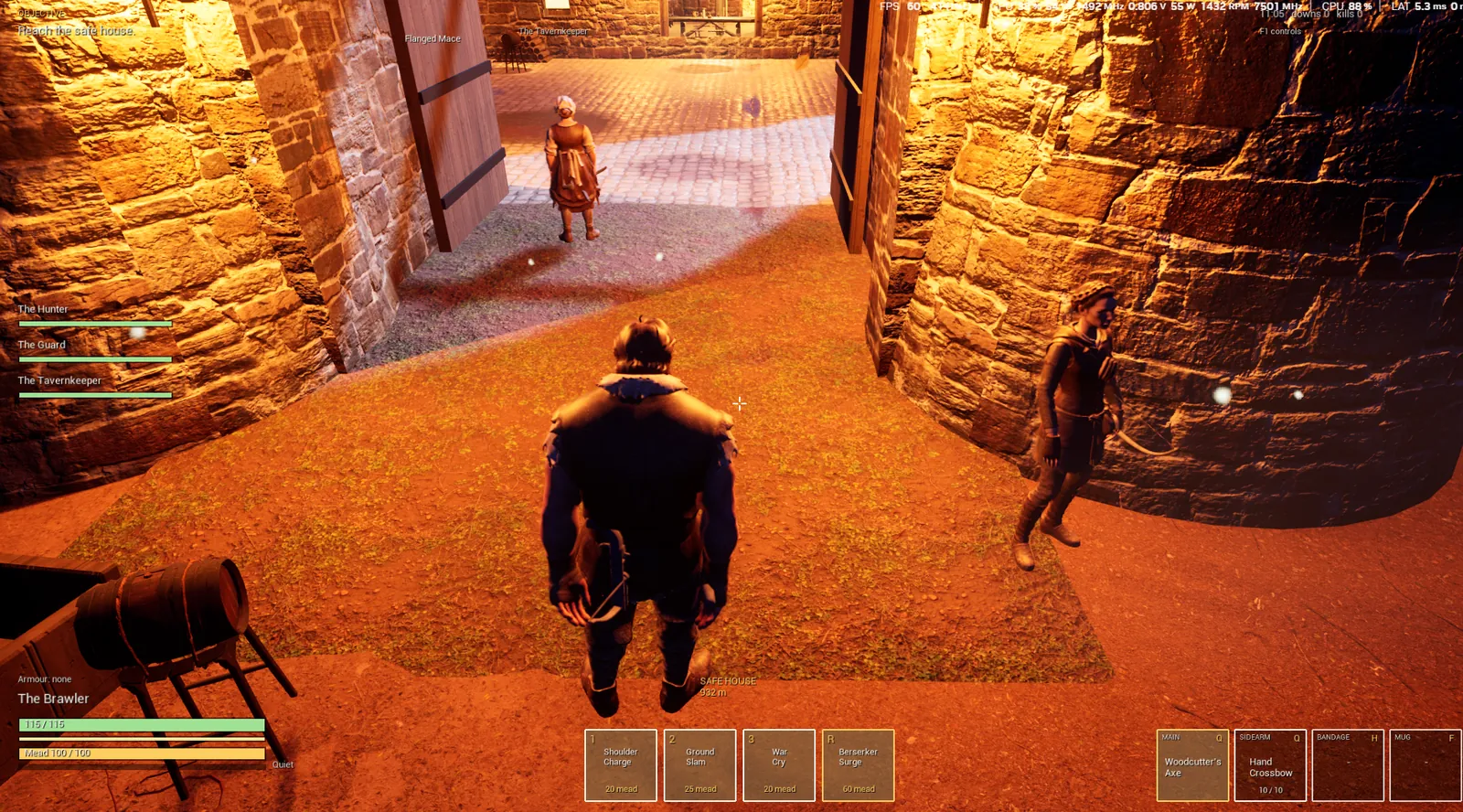
TL;DR: Sunday was my longest day of the jam, from breakfast to well past 11 PM. Segment 1 became a moonlit night, the spawn point broke and got fixed, the castle was rebuilt with real logs and 3D stone, 108 free Megascans assets went into the world, and all four heroes got leather, mail and plate armour. In the evening I sat down and properly played it for the first time. It wasn’t fun yet, and I said so. The list I wrote that night shaped everything that happened while I slept.
Overnight: menus, specials and armour
Codex and Claude kept going while I slept. The native menu screens and a compact HUD went in at 3:21 AM (PR #102). This was the UI rework I’d been building towards since Friday: the mockups and the medieval art kit, rebuilt as real screens in C++ so Codex could build and test them without anyone watching. Next to it came the director’s special spawning and horde requests (PR #103), so the pressure director can now send specials and hordes at you rather than just track how you’re doing.
At 5:40 AM the first special with its full behaviour arrived: the Strawman (PR #104). It hides among the scarecrows in the fields, and you won’t know which one it is until it moves. At 6:18 AM the Guard’s modular armour went in, with leather and plate pieces fitted to the shared skeleton (PR #105). It’s the first proof that my heroes can visibly upgrade their gear.
Morning: I play it, and make the calls
I picked up the build over breakfast and made a run of decisions.
The first was the camera. I’d always planned first person, and the build was third person. So first person is now the default, and one key (V) switches to third person. In the first version you could look down and see your whole body, with no head. You should see your arms and legs, not a headless body, so that’s being changed before it goes in.
The second was the castle. I looked at the courtyard and wrote, “this is not a castle? huge work still needed.” It was still blockout dressed with a few props. Claude started a full rebuild in its own thread, with a keep, towers, a gatehouse, crenellated walls, wet cobbles and a proper beamed tavern, all in real stone and wood materials. That rebuild is finished, and it’s waiting to go in until the spawn fix below lands.
The third was how Segment 1 ends. Before the safe zone at the village gate, the party fights a Thorn Hulking. Partway through, the Briar Warden appears on the village’s great walls, out of reach, and fades into the mist. Segment 2, after the jam, opens in the village tavern: empty, with the mead spilled across the floor.
The fourth was the bots. They clustered together and followed far too closely, like ducklings. Real players don’t do that. They spread out, wander off to check a doorway, and regroup when things go wrong.
And finally, the priority. Single-player look, feel and playability come first, and online play waits until that’s solid. Level art and atmosphere matter as much as gameplay, and the setting is night: moonlit enough to see enemies, with fog, torches at landmarks and the odd shower of rain.
What landed by mid-morning
Most of that was in the build within about two hours. The night atmosphere for Segment 1 (PR #112) gave it a moonlit sky with stars, ground fog, dark muddy tracks in place of the white cobble strips, braziers and torches at every location, and a lit arena for the boss fight.
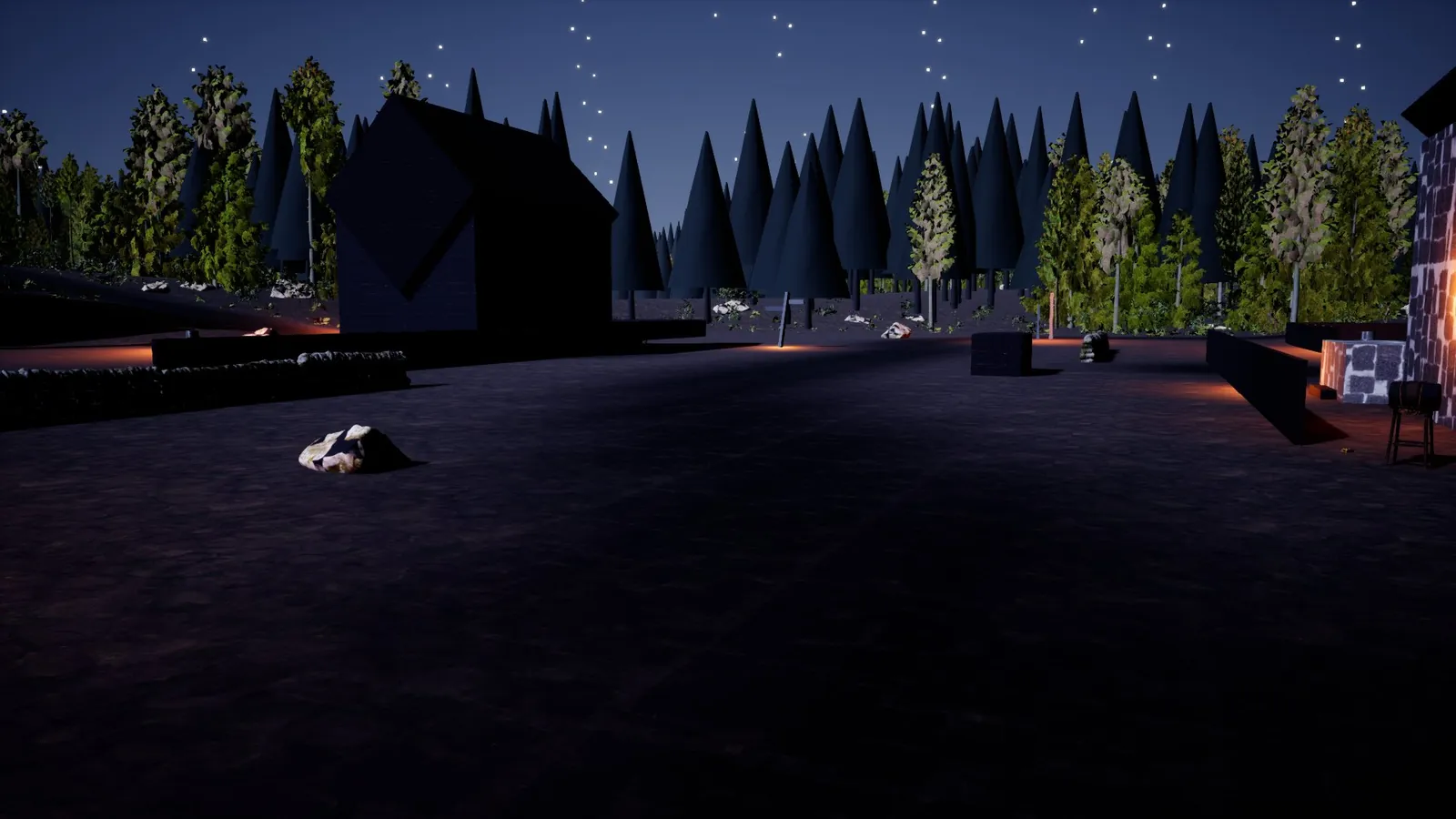
The farm after the night pass. Braziers mark the way, and the fog hides the edges.
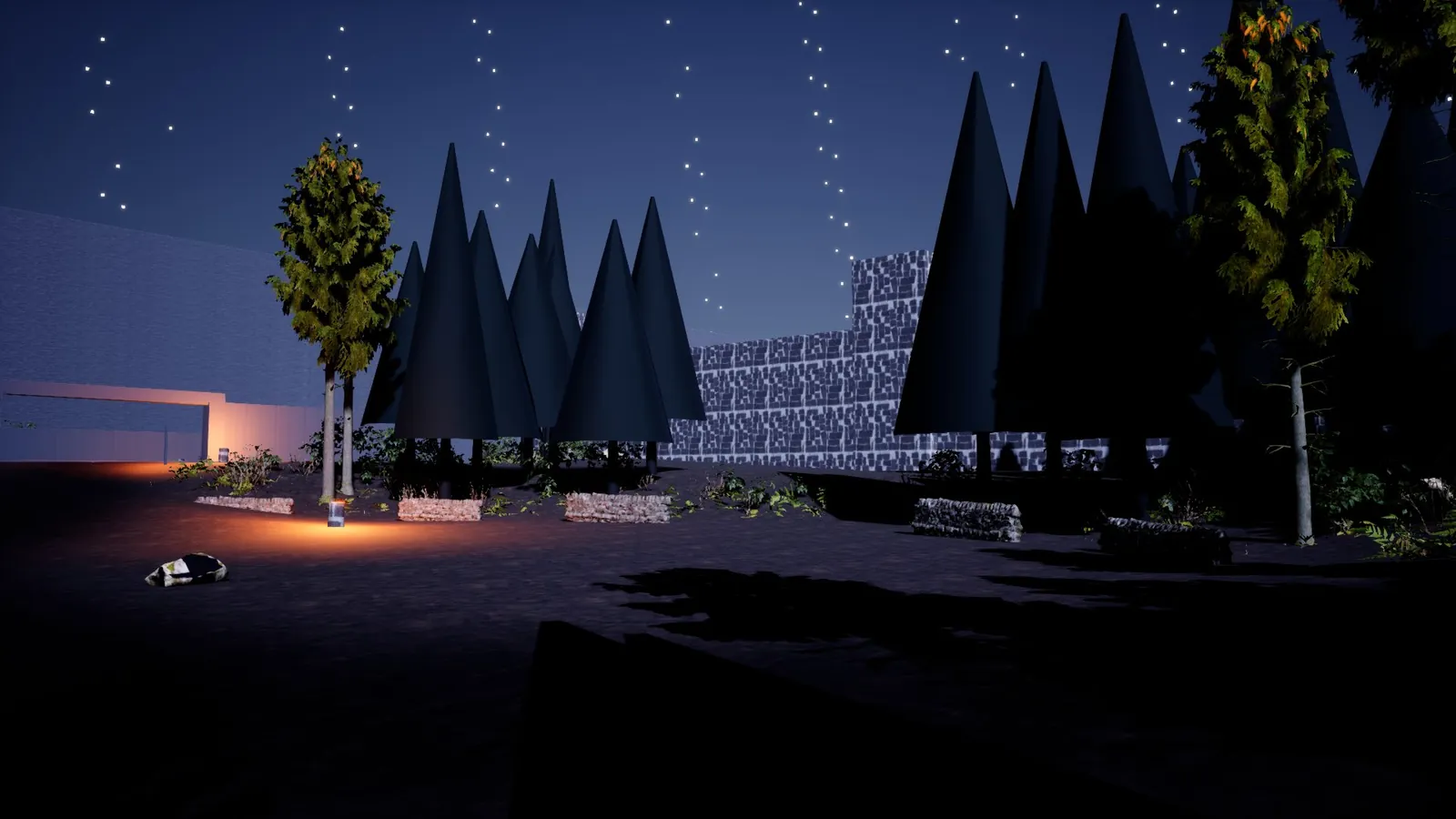
The boss arena before the village gate. This is where the Thorn Hulking waits.
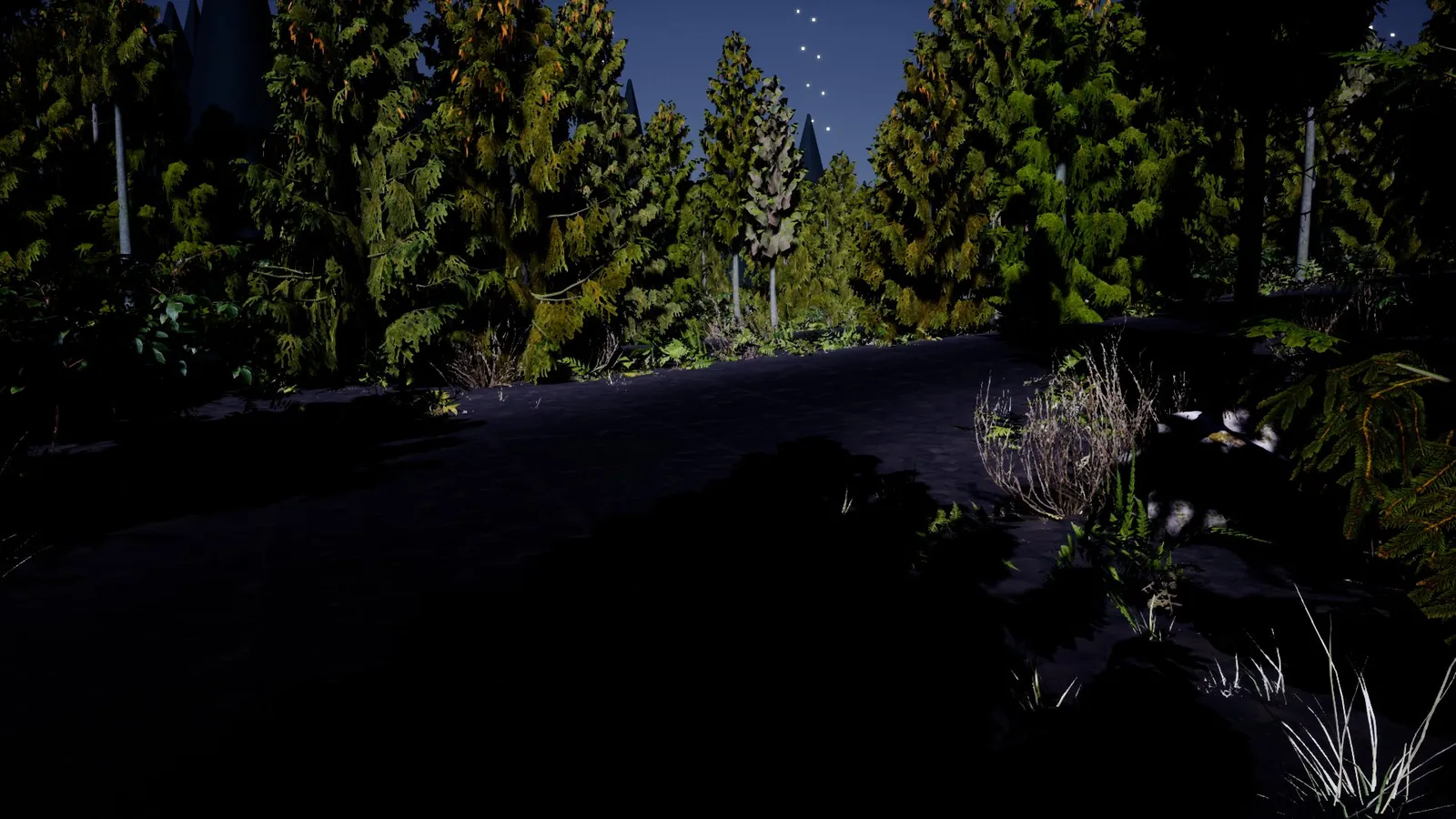
The field road at night. You need to see Thralls coming, but not much further.
The front end now flows into a playable run (PR #107): a splash screen, the title, single player, a lobby where you pick your hero, difficulty and bots, then Segment 1. Escape opens Resume, Settings, Restart from checkpoint, Leave to title and Quit. Claude packaged it all into a build with a “Left for Mead” shortcut on my desktop, so I can play it like a real game.
The bots now spread out (PRs #108 and #111). Each one takes a spot a few metres off the leader’s path, keeps its own personal space, lags or leads a little depending on its personality, and wanders over to look at nearby loot when things are quiet. When a threat appears, they close back in.
The Briar Warden apparitions went in (PR #115). The druid now appears at a distance at key moments along the route, the way it will on the village walls.
And a batch of Rodin props arrived (PR #116): four shields, three helmets that fit every hero, a bandage, a tankard, a bottle, a bear trap, a thorn kit, a crossbow bolt and a war hammer. Nine armour pickups followed, with chest, gloves and boots for each tier, so every pickup in the game now has a real model. Each item started as a Meshy concept picture and became a 3D model in Rodin, and the whole batch used about 22 of the 208 Rodin credits from the jam perks.
More Thralls, more armour
So that a horde doesn’t look like a crowd of clones, I asked Claude for prompts for five new cursed villagers, each with a different build, age and mutation: a milkmaid, a heavy farmhand with a root mass growing out of his back, an old widow crowned with twigs, a blacksmith’s boy with thorns along his spine, and an alewife with bark plates across her chest. I generated turnaround sheets for all five in ChatGPT and liked every one of them. They’ll go through Tripo as credits allow, once the hero armour is done.
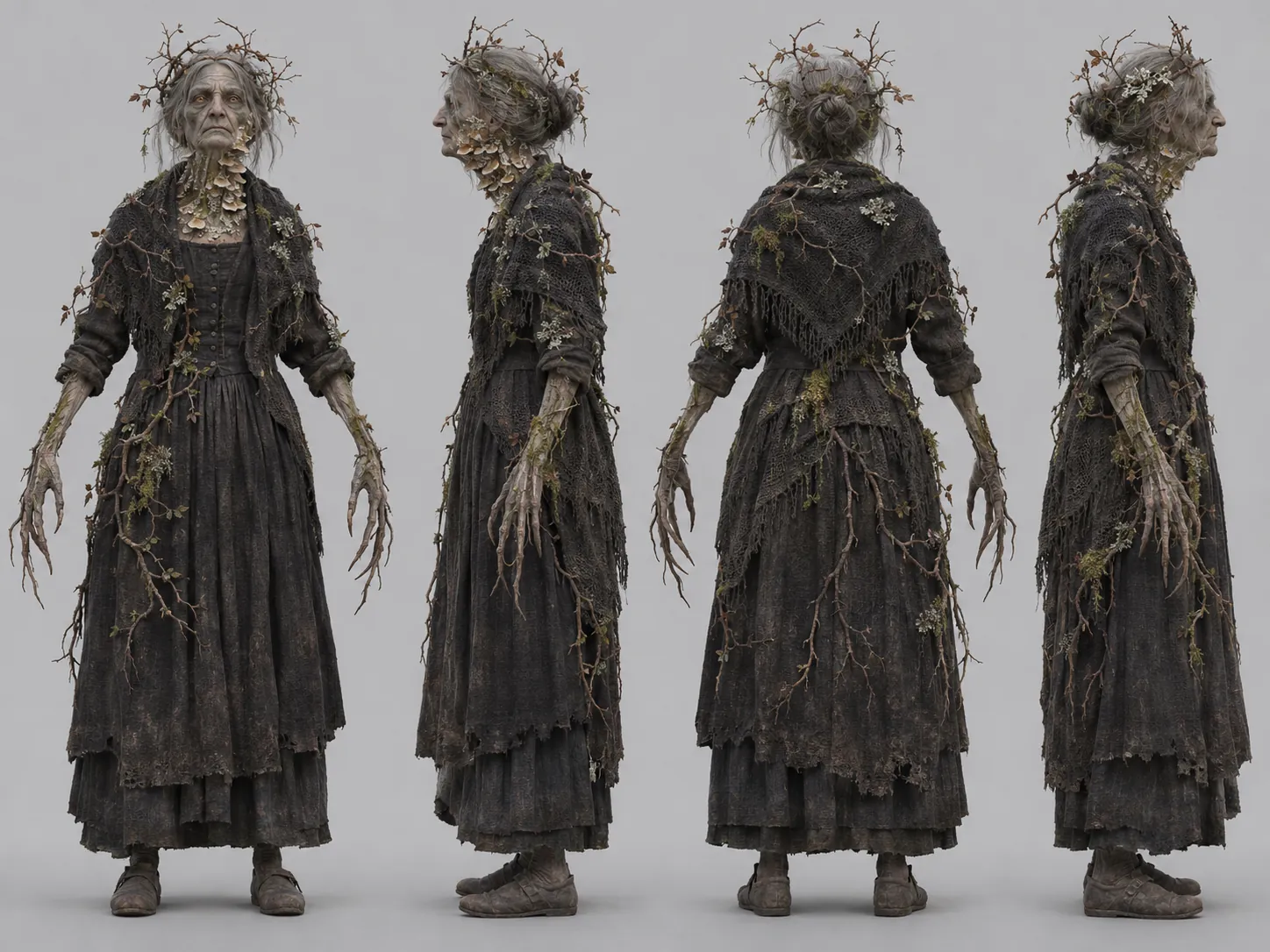
The widow Thrall’s turnaround sheet, which I generated in ChatGPT from Claude’s prompt. It’s the input for Tripo, not a finished model.
Fixing the spawn, and filling the world
The broken spawn turned out to be a strange one. The night pass had added a sky dome, and its collision was catching the heroes as the level loaded, so they started about 2.5 km outside the map in empty fog. Claude found it and fixed it (PR #120), and by mid-morning the party was back in the tavern where it belongs.
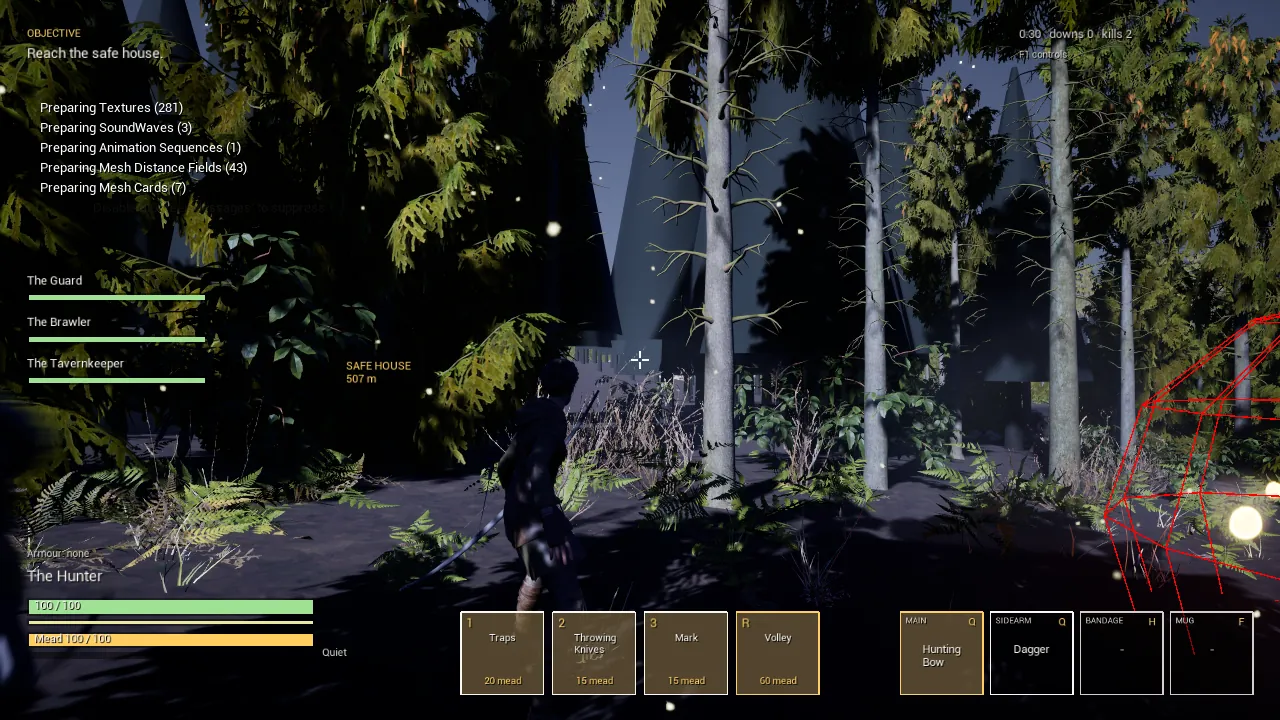
Back on the route after the spawn fix. The text in the corner is the engine still compiling shaders on first load.
Then I looked properly at the ground and didn’t like it. It was smooth and shiny, like a stand-in. I wanted real dirt, leaf litter, stones, sticks and debris, and I set a rule for the whole world: no flat surfaces anywhere. I want to believe the place is real, and flat textures break that instantly.
Claude made one exhaustive download list for Segment 1, and it kept growing as I thought of things: wheat, fences, every castle and farm piece, barrels, tables, chairs, lanterns, torches, candelabras, crates, farm tools, haystacks, broken carts and wheels, church pews, scattered books and a fallen church bell. It ended up at 108 free Megascans items. I also asked that loot should belong where you find it: a sword in the barn, an old weapon on a skeleton by the road, a bandage in the outhouse, mead in a kitchen. Nothing floating in the air.
All 108 downloaded once I’d clicked through an Epic sign-in, and the dressing passes started landing one after another (PRs #125, #126 and #130). The ground got a matte forest floor with leaf litter, the roads became mud and gravel with sticks and stones along the edges, and fallen adventurers now hold stashes. The road also leaves the path on the ridge and pushes about 70 m through the trees to a woodcutter’s clearing, with an axe waiting in the chopping block. And it turned out the Megascans props had no collision at all, so you could walk straight through them. Every solid prop got collision.
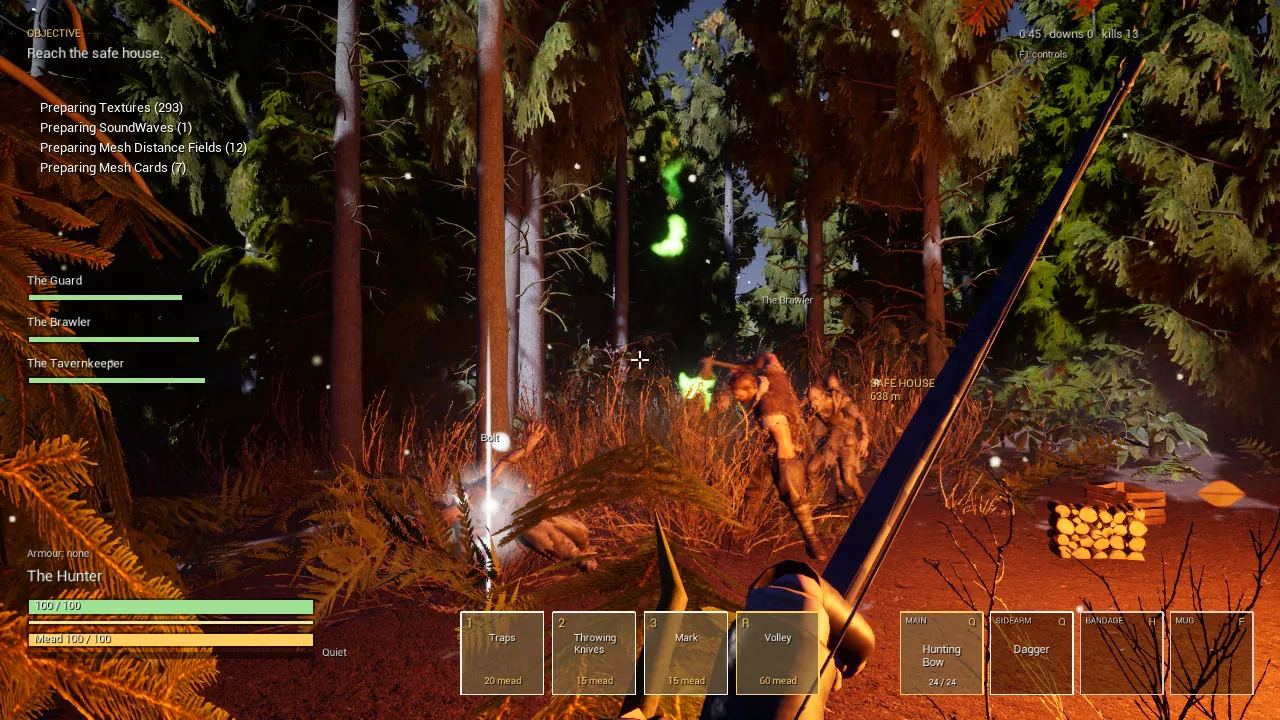
The woodcutter’s clearing, the short push through the forest.
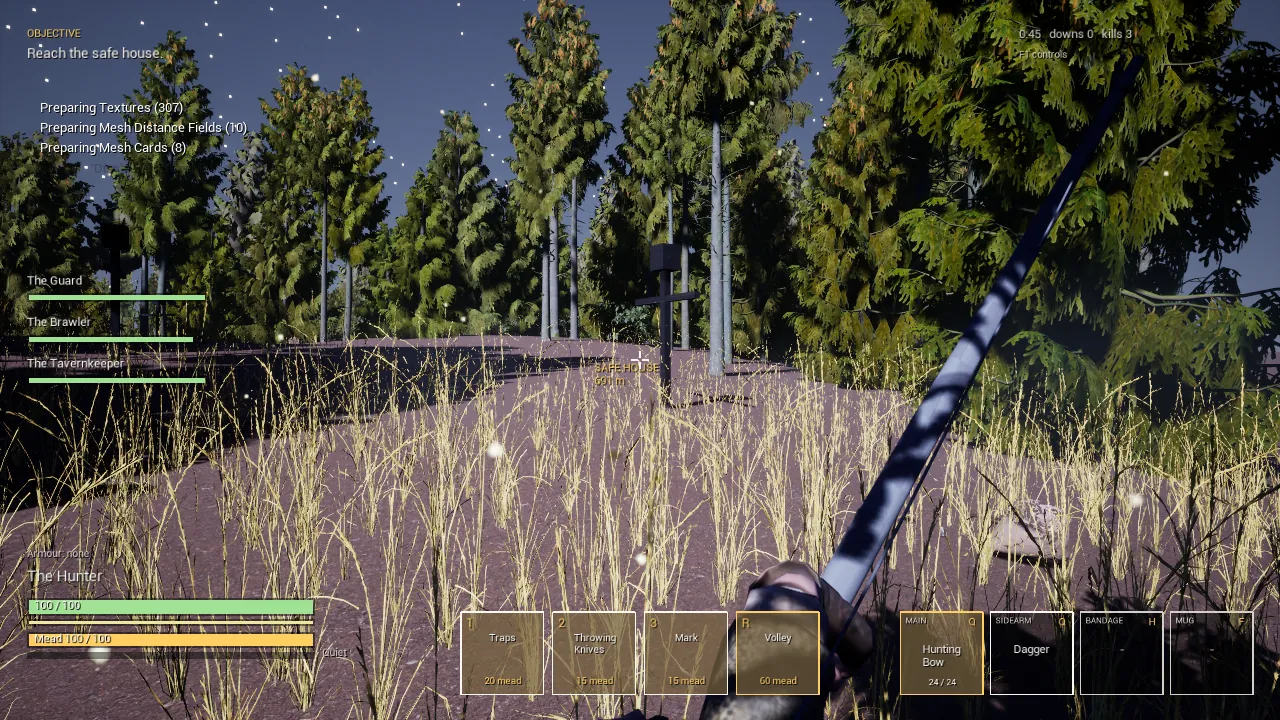
The first wheat crossing. It was far too sparse, and I said so that night.
Later in the afternoon the roads started to breathe (PR #133). They now swing between tight pinch points and wider stretches, with clutter every 30 to 45 m and fenced paddocks for animals you can see but never reach.
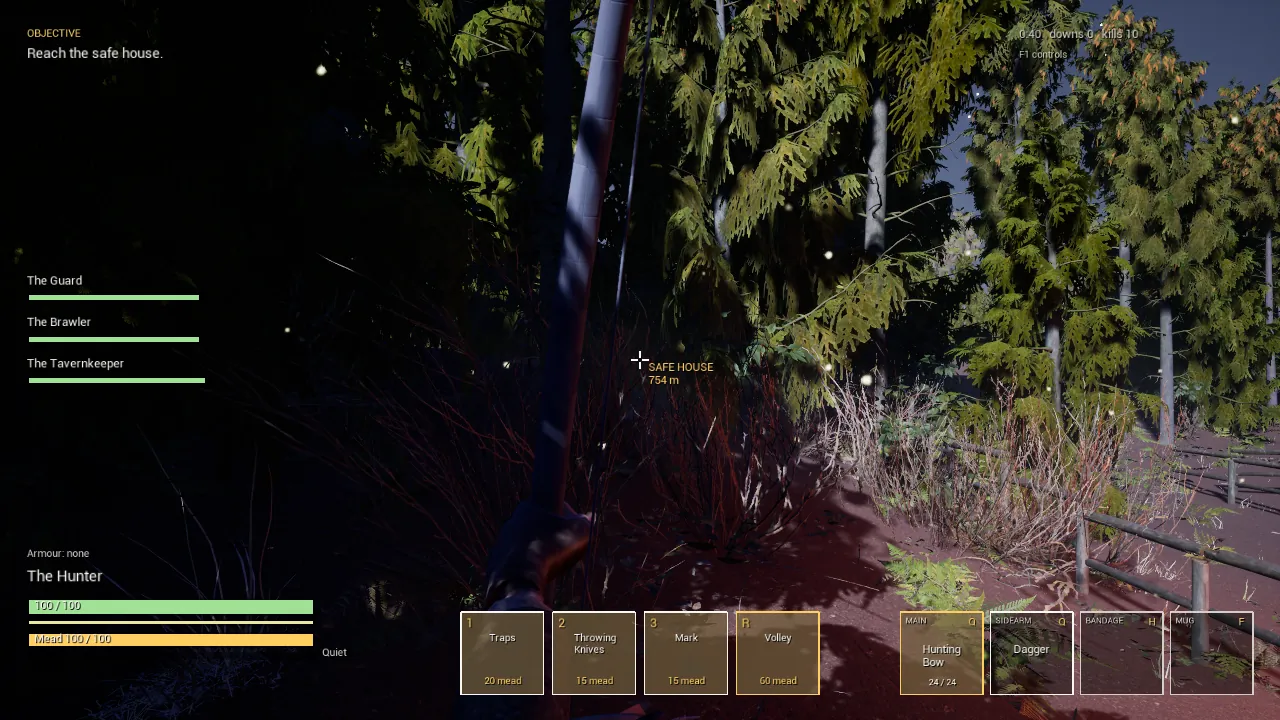
A pinch point on the road after the dressing pass.
A real castle, and a calmer start
When I walked out of the tavern on the first pass, my honest reaction was “this is not a castle”. It was a few grey walls and a gap. So Claude threw it out and started again from nothing.
The new castle comes from an original kit that a Blender script builds piece by piece: crenellated curtain walls, four round drum towers, a gatehouse with D-shaped towers, machicolations and a portcullis, a tall keep you can see from the road, and a slate-roofed hall wrapped around the tavern. The stone and timber use free CC0 materials from Poly Haven with Nanite tessellation, so the walls have real depth instead of a flat picture of stone. I’d pointed out that roof beams wouldn’t be square, they’d be logs, so the tavern now has adze-hewn timbers overhead (PR #122).
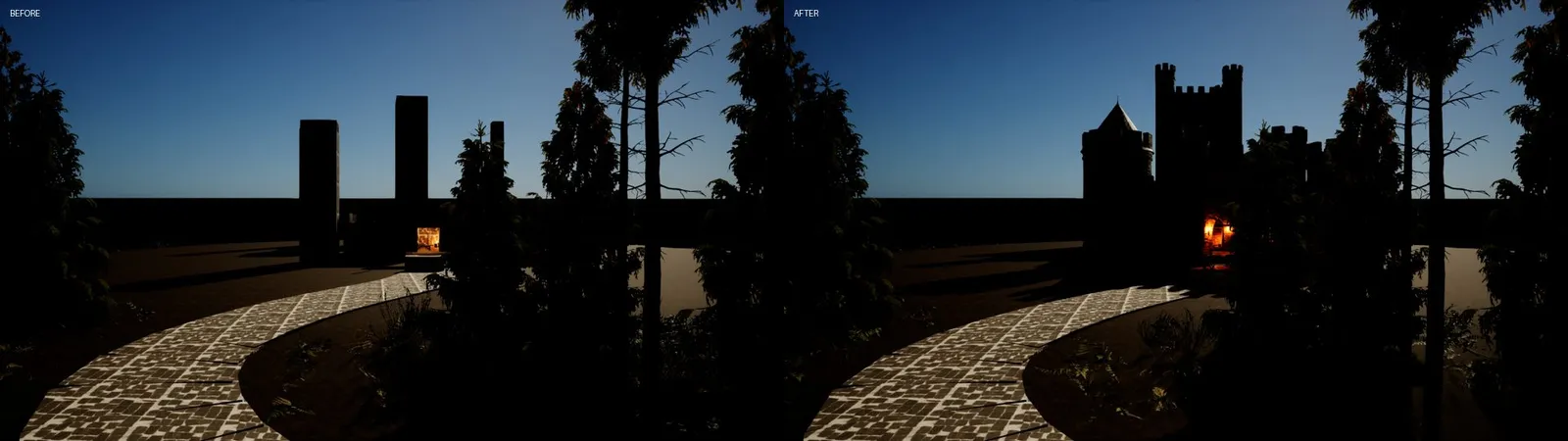
The castle from the road, before and after the rebuild.
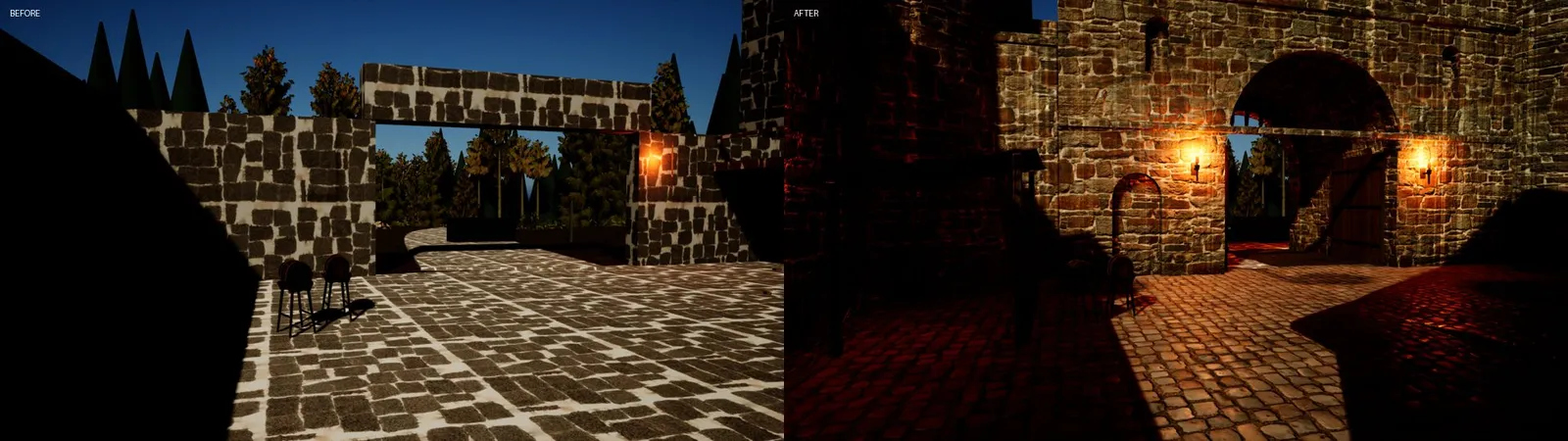
Looking from the courtyard to the gate. The square hole became a proper gatehouse.
The tavern took several rounds of me playing it and saying what felt wrong. The furniture was the size of a giant’s, so it was all scaled down to human height. The bar came out from the wall with a walkway behind it, made from a single hewn counter. Behind it there’s now a three-tier rack of mead casks with taps, the tables run in rows down an aisle to the bar, and there’s a small stage for a bard (PR #129, with the layout rework following on). Megascans filled in the rest: the fireplace, stools, chests, a cauldron, a cart, crates, sacks, hay and a well in the courtyard.
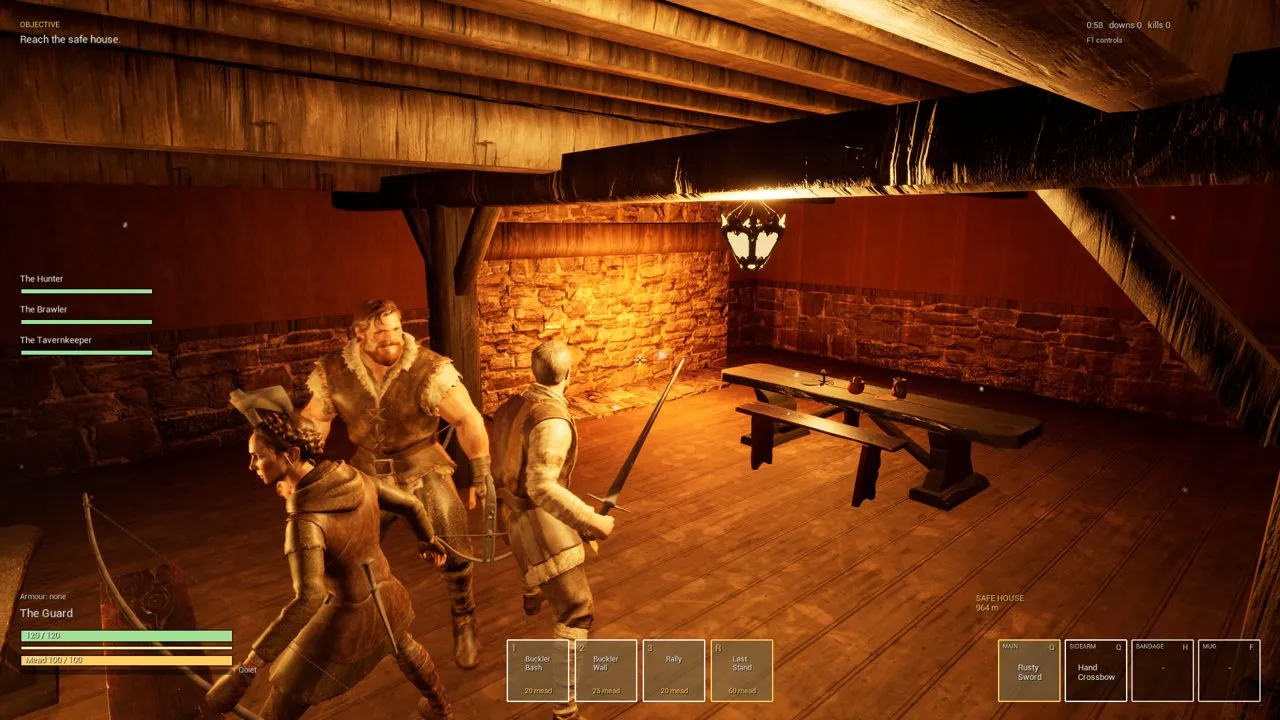
Log beams and real 3D stone. This is where the run starts.
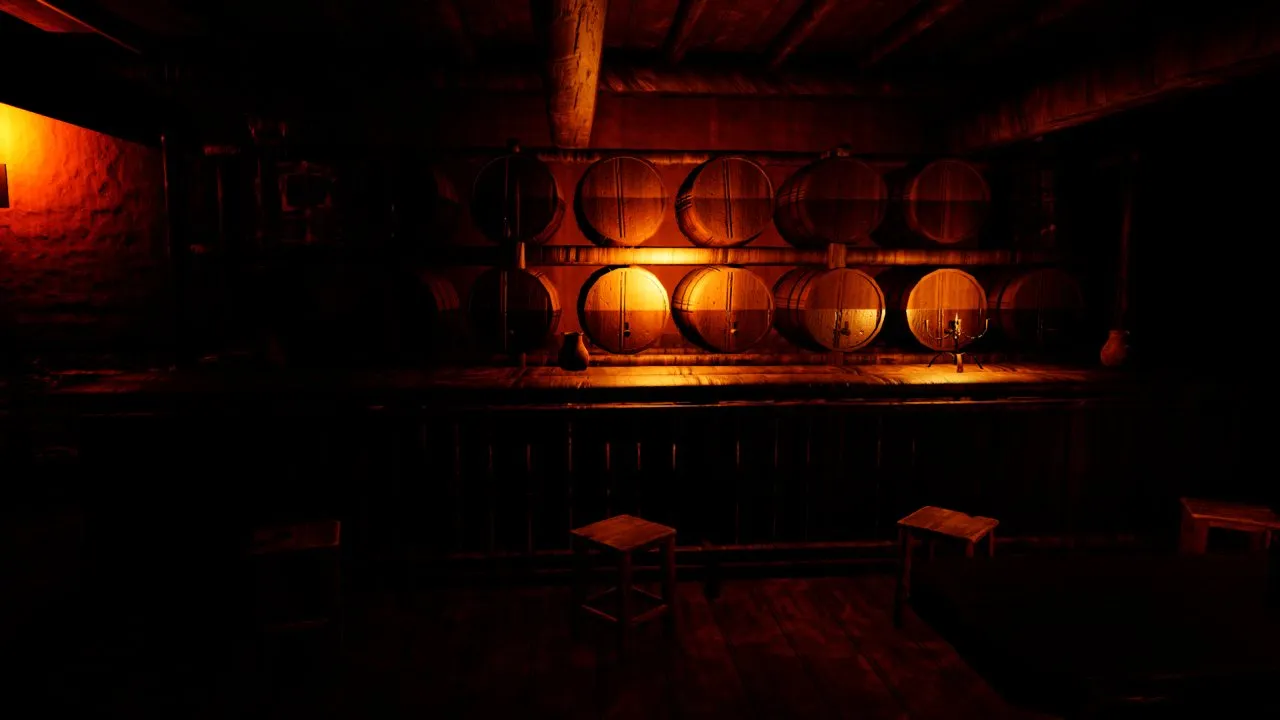
The cask rack behind the bar. The mead has, of course, run out.
One unglamorous but important fix: Claude wrote a collision audit that checks every one of the 118 props actually blocks you. It found that the whole banquet furniture set had no collision at all, so you could walk straight through the tables. That’s fixed, and the check now runs every time.
I also noticed the heroes looked around nervously the whole time, even inside the castle with nothing happening. So now they relax in the tavern and courtyard and only switch to an alert idle once they pass the cart (PR #121).
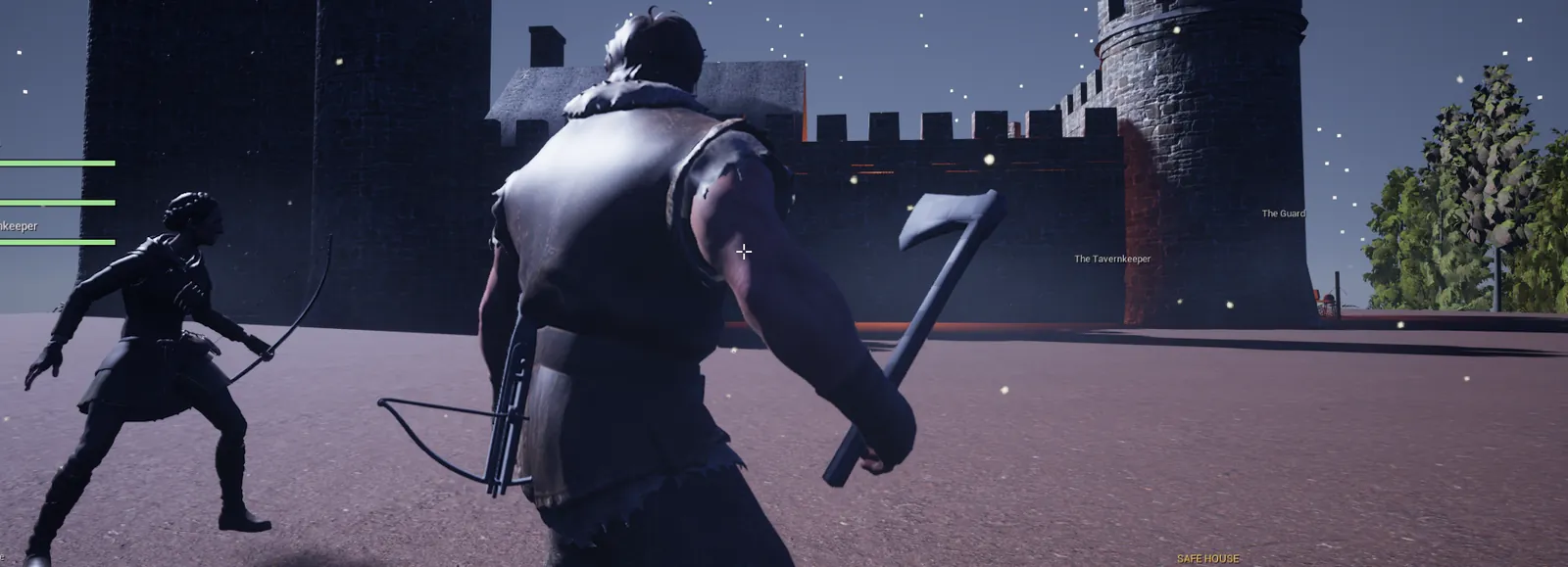
The Guard and the Hunter outside the rebuilt castle.
Arrows, crouching and a better ending
A few smaller design calls went in through the afternoon and evening. Bows and crossbows now have finite ammo: 24 arrows, some of which you can pull back out of the ground or a body, with bundles and quivers placed where you’d expect them (PR #124). Pickups lost their glowing beams and orbs and just catch the light now and then (PR #132). Enemies got grounded warnings before their big attacks, so you can read the Warden’s Thorn Lash, the Strawman’s sweep and the Bramble Runner’s lunge (PR #131). The Bramble Runner itself was finished by Codex (PR #119). And you can now hold Ctrl to crouch and sneak past sleeping Thralls without adding to the Ruckus (PR #137).
The biggest idea came to me in the evening. I didn’t want the ending to be “the Warden appears and you walk in”. Now you have to knock on the village gate. The Warden hears it and summons the Hulking, but you don’t know that yet. All you hear is a huge crack, like a tree splitting in the woods, and about fifteen seconds later the Hulking walks out of the treeline while you hold the gate. Claude suggested three to five minutes of holding out rather than ten, so it doesn’t drag, and made the tree-splitting and summoning sounds (PR #136).
Every hero in three tiers of armour
I spent a big part of Sunday in Tripo and Blender myself. I’d never really used Blender before, and it showed. When I couldn’t see or select the armour pieces under all the other models in the scene, Claude told me not to bother: just Save As the whole scene and it would sort out which piece was which. By the evening I’d made mail and plate for every hero, and the three new Thrall villagers (the Milkmaid, the Farmhand and the Blacksmith’s Boy). All four heroes now have leather, mail and plate armour in Unreal (PR #138).
The evening playtest
Around 10 PM I sat down with a fresh build and played it properly. It was humbling. In about forty minutes I sent Claude more screenshots and notes than on any other day:
- The screen jittered constantly in first person, badly enough to affect playing.
- Weapons and crossbows were plain grey with no textures, and the Brawler’s wrists bent around his axe.
- Walking looked like sidestepping forward, and sprinting pushed the axe through the Brawler’s face.
- The menus were chunky and oversized, the “Left for Mead” sign was hidden behind the menu, and there was a redundant screen between the title and the hero select.
- The farm was still mostly blockout, the wheat faded out unless you were right next to it, and you could run all the way round the outside of the castle.
- The night was too bright, you could see through the forest to the empty world beyond, and the stars sat in an obvious pattern with no moon.
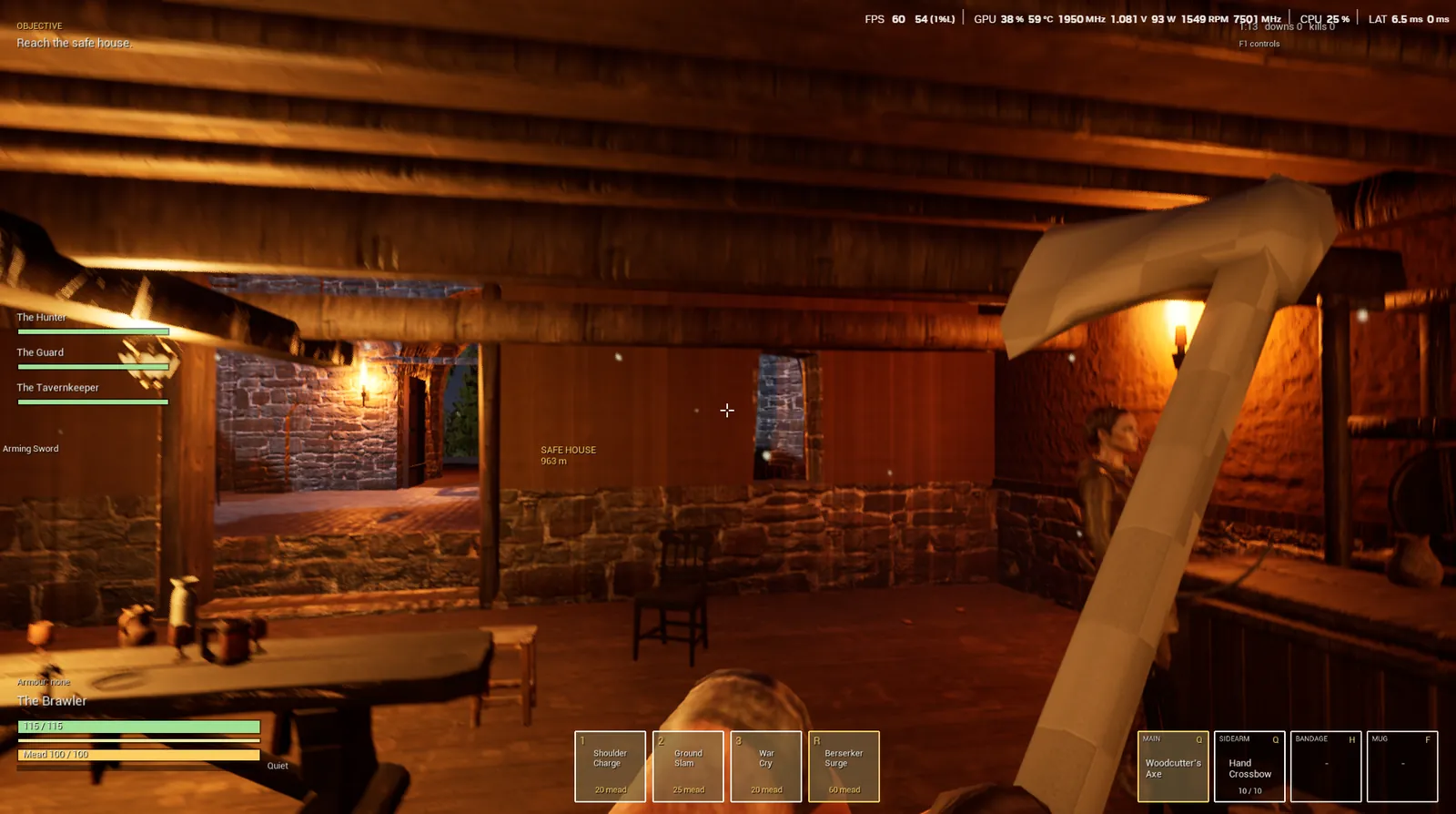
The new tavern looked good. The grey, untextured axe in my hand did not.
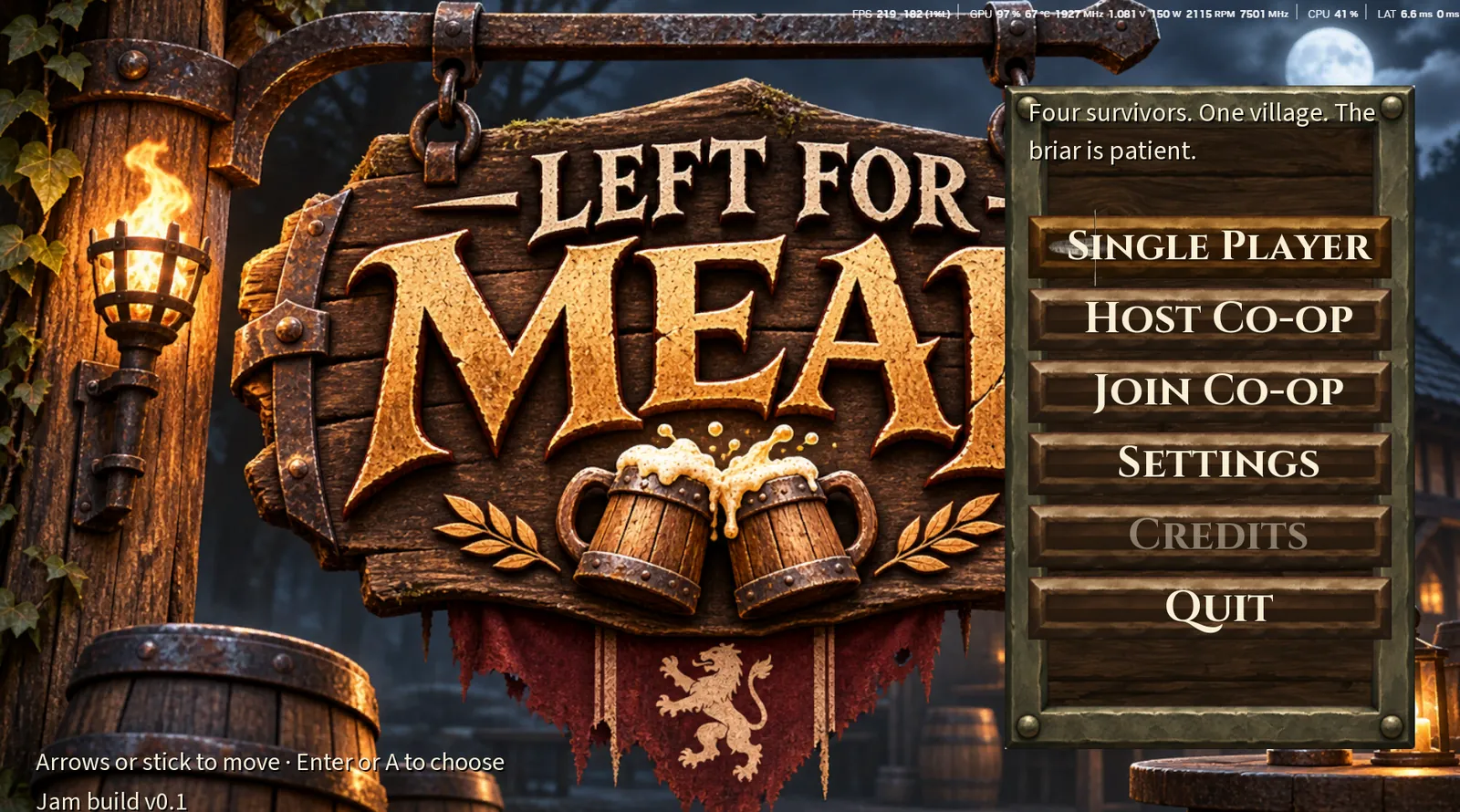
The main menu before the polish pass. The sign is hidden and everything feels oversized.
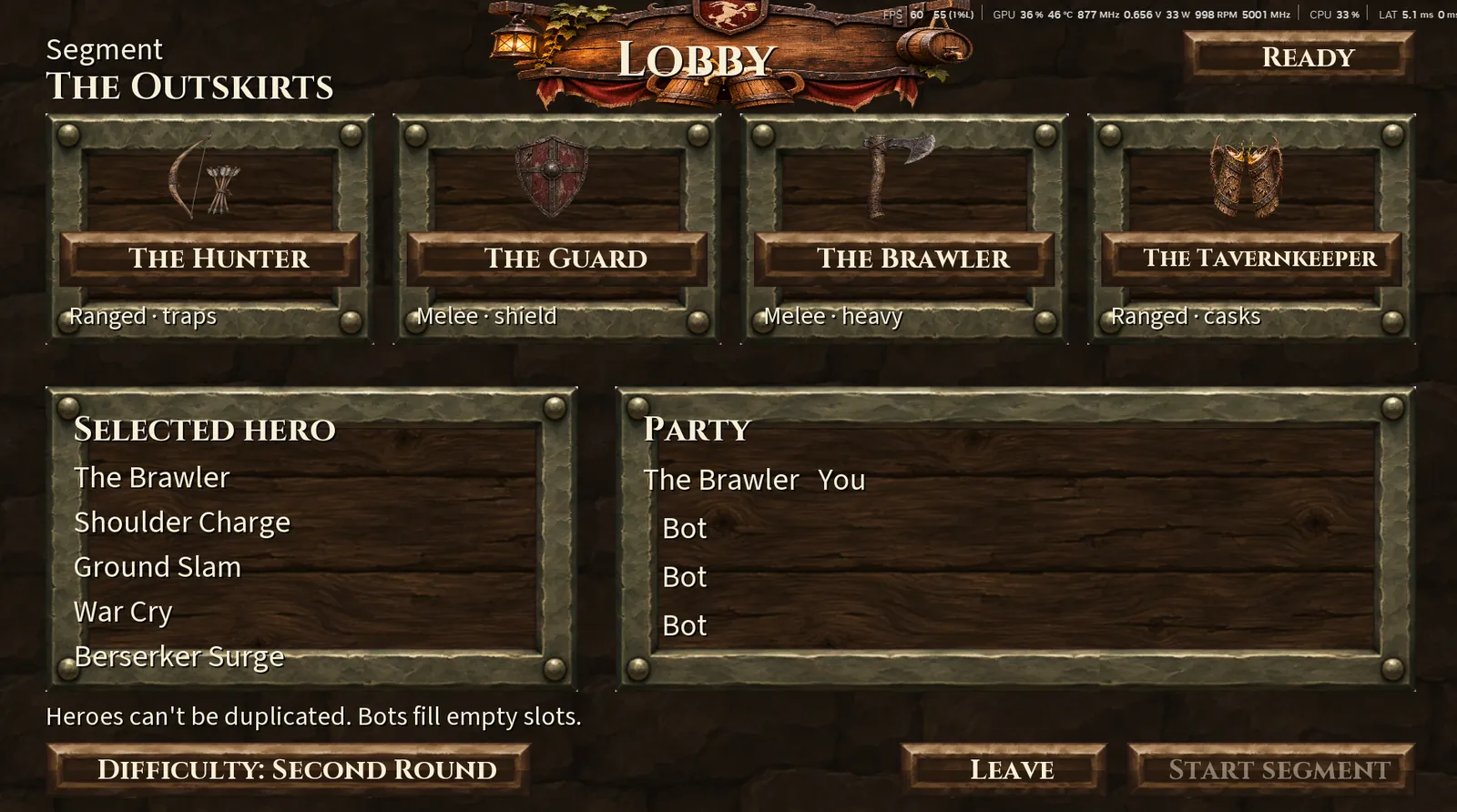
The old lobby. It took me a moment to even find the Ready button.
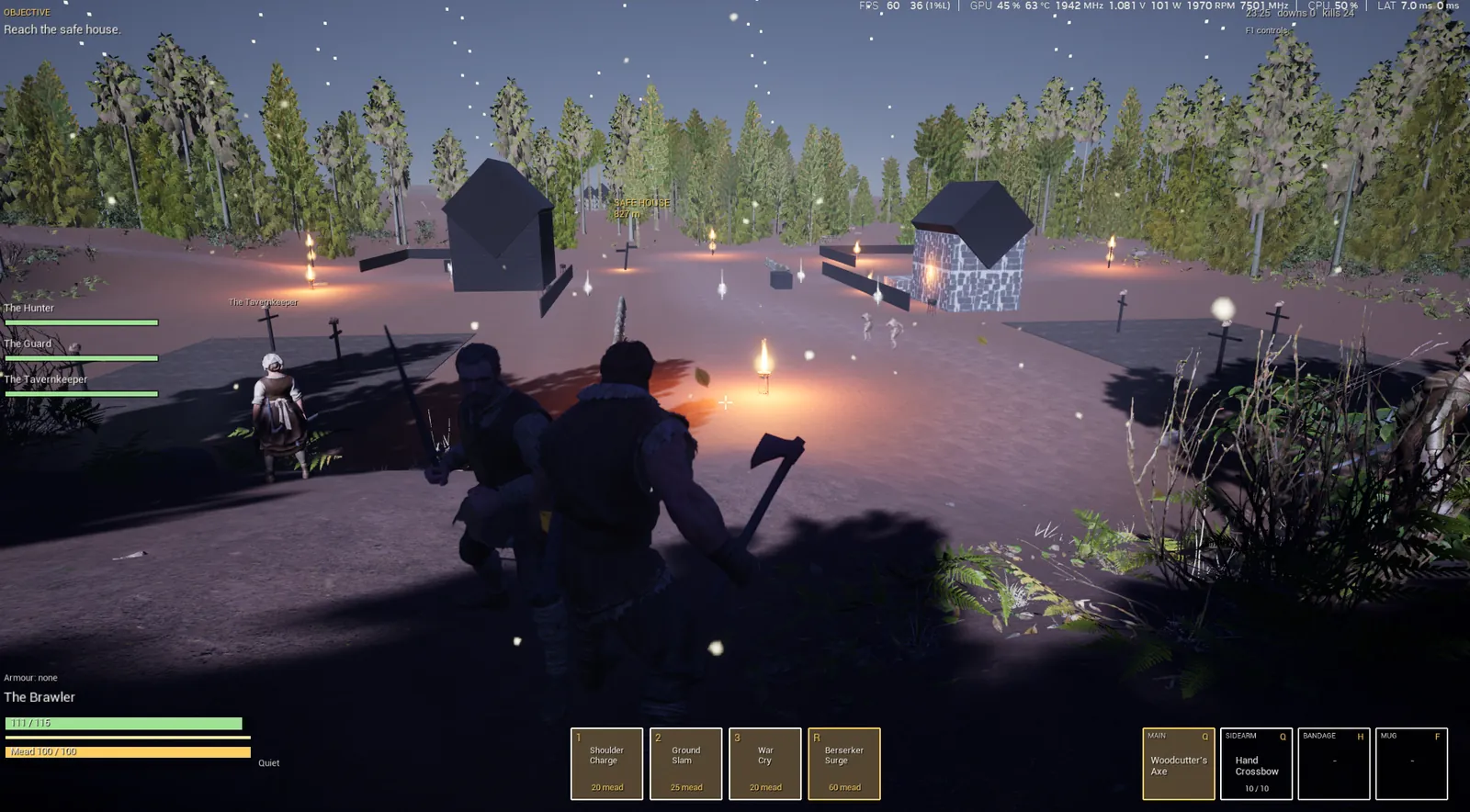
The farm on Sunday night: still boxes, and the weakest part of the map.
Near the end I wrote something I’ve thought about a lot since: “I’m not sure it’s actually enjoyable to play as of yet. There’s probably not enough polish. But I think the premise and what we need is here to build out and become better.” I also realised the weapons had no weight at all. No impact sound, no stagger, nothing to tell you you’d hit something. Claude turned the whole list into a priority order, and almost all of it started that night.
I moved our content lock from 10 AM to midday on Monday, so there’s time to test, film the gameplay video and fill in the forms. Codex was down to about 12% of its weekly allowance, so I told Claude to spend all of it overnight on the most important fixes. Then I went to bed.
The hard parts
Sessions going offline. From about 3 PM to 5:30 PM nothing moved on my PC. The level session and the Codex session had both quietly gone offline while I was out. Once I noticed, both restarted, but that was two and a half hours lost on the second-to-last day.
Disk space, again. The Medieval Village pack is exactly the look I want, so I tried to download it. It needed another 1.57 GB, because the Epic Launcher’s download cache lives on my C: drive, which is nearly full. Moving the cache fixed it, but the download ran overnight.
Texturing gaps. When I textured the Tavernkeeper’s mail in Tripo, it left a bare gap between her dress and her apron, hidden in the mock-up and so never painted. Claude’s advice was not to spend credits re-texturing and to fix it in Blender instead.
Not as good as the sample. Looking at the Medieval Village screenshots, I asked why our game didn’t look like that. Claude’s honest answer: that sample is hand-dressed by artists with a matched kit and tuned lighting, and ours is built by script from blockout. It’s a fair gap to have after four days, and the pack is in our library now to close some of it.
Size. The Sunday build was 988 MB, or 667 MB zipped. It’s still under the 1 GB ceiling, but only just.
Tools I used, and for what
Codex CLI built the Bramble Runner, finite ammo and the attack warnings. Claude Code Desktop on my PC fixed the spawn, rebuilt the castle, dressed the world, imported the armour and packaged the builds. Fab and Megascans supplied the 108 assets, Poly Haven the stone and timber materials, and Mixamo the calm idle. Tripo and Blender turned my sheets into armour and new Thralls, Meshy and Hyper3D Rodin made the props, and Claude made the sounds of the Hulking coming through the trees.